Showing posts with label electrical safety. Show all posts

Thursday, June 21, 2012

Teaching Kids about Electrical Safety at Home


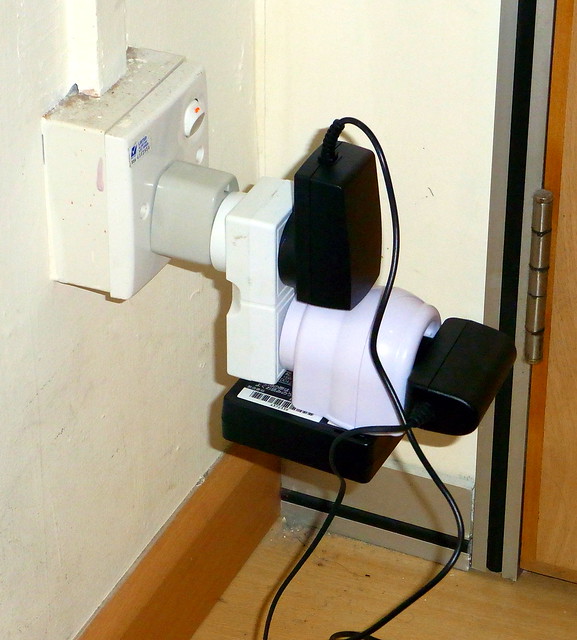
Practise what you preach – teach kids plugging too many plugs into one socket is dangerous, and then don’t buy plug extenders! Image via Tolomea

It’s estimated that there are close to 3000 accidents at home resulting from electric current every year in the UK, and unfortunately almost a quarter of these accidents happen to children under the age of 15.

Not all of these accidents were fatal, but some were. Even if an electrical accident doesn’t kill you, it can still cause a serious and sometimes life-changing injury, or cause a secondary risk such as a fire.

Children, especially young ones, are often unaware or unable to comprehend these risks, so it’s important that as their parent or carer you take the necessary precautions to keep them safe.

Here are my top tips on teaching kids about electrical safety:

Explaining Electricity

First and foremost, you may need to explain to your child just what electricity is!

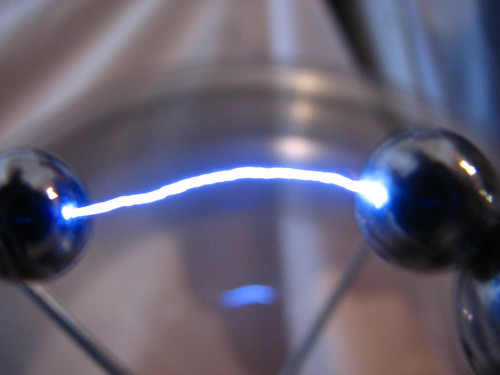
Young children have no concept of things they can’t see, so it may be useful to take them to an exhibition or museum where they can see static electricity in action, and explain that the electricity at home is the same but ‘invisible’ and can be dangerous.


Static electricity shows can be a great way to help young kids visualise electricity. Image via Ericskiff

Sockets

Most electrical sockets nowadays are fitted with safety catches to cut off the flow from the earth wire if little fingers go prying around inside, but older ones aren’t, and even if your sockets are brand new, is it really worth the risk?

Teach children that nothing – fingers, toys... – must ever be put into the sockets on the walls.

Young children in particular love to do what they’ve been forbidden to do, so it’s also a good idea to invest in some high-quality socket covers that only an adult can pry off. Yes, it’s annoying having to take them in and out every time you want to vacuum or iron, but you cannot put a price on the safety of your child.

Appliances

The same goes for appliances – teach your children the dangers of putting a knife in the toaster, or touching the back of the TV.

If you’re guilty of these things yourself, make sure your child never sees. Kids learn by imitation and he or she might not have noticed that you only put the knife into the toaster to get your stuck toast when it was switched off!

Remember to teach kids about the dangers of mixing electricity and water. Explain that electricity can travel through the water and hurt them, even if they’re not touching the appliance!

Show them that there are no sockets in the bathroom for this reason, and explain that anything that’s plugged in must be kept well away from bath tubs and sinks. Even electric power showers can be dangerous if faulty so ask them to tell you immediately if they notice something broken.


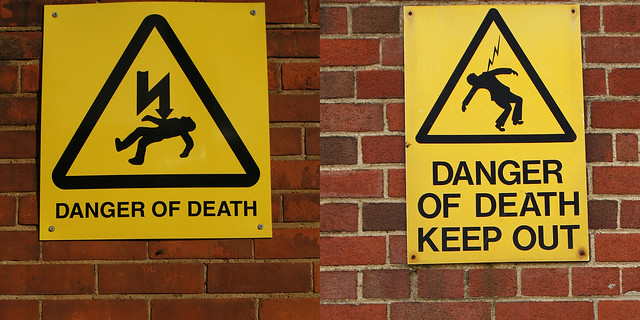
Teach young kids to recognise danger signs. Image via Jonny2Love

Power Lines

Electrical safety extends further than just the home. Show your child a “Danger High Voltage” alert, electrical warning signs and even just what a transformer looks like (as unfortunately they don’t all have signs!) and explain that they must keep well away from power lines, transformers and other electrical equipment they may come across outdoors.

Don’t let children fly a kite near power lines, or climb nearby trees. Again, explain that electricity can travel through the kite string to them, and that electricity can jump so the kite doesn’t even need to touch the wires to be dangerous.

Teaching your children about electrical safety can save their life – but don’t rely on them understanding or behaving! Kids are notoriously contrary, so take the necessary precautions yourself too such as installing socket covers and fixing faulty wires the moment you spot them.

It’s always better to be safe than sorry!

Sunday, October 24, 2010

Fire Investigation and Junk Science


Why you could find yourself a criminal suspect or civilly liable if you’re involved with a fire.

by Nick Markowitz, Jr.

Everyday there are people who are charged with arson when a fire has taken place in their home or place of business.  How many times charges are warranted is a subject being hotly debated in the fire community today.

The problem is a general lack of training for some investigators. There's even an on going debate among trained investigators as to the cause of these fires. All of this has unfortunately lead to people being arrested and eventually convicted of arson. Many are found civilly liable for causing a fire that they may not have had anything to do with. In one case a Texas man may have even been executed for the crime of arson when he may not have done it.
Now you say to yourself, “WOW! How can this happen in a modern world with DNA and advanced investigative techniques?” Well, it does, and it happens easier than you think. The worst part is trying to right a wrong in court after you've been convicted. It can take decades to be exonerated.

At any one time in this country there are various innocence-type organizations that are fighting for wrongly-convicted people. This includes not only rapists and murderers, but arsonists, too. There are excellent organizations like the IAAI (International Association of Arson Investigators) that provides standards for the training and certification of fire investigators. This includes the prestigious CFI certification. While it is not mandatory in some states to have this or any other type of certification in order to investigate fires, many states, including my own, does not even require that you be certified as  private investigator.

While fire investigators are required to follow the Guidelines of NFPA 921 on fire and explosion investigations, which bases its standards on the Scientific Method, this manual is often looked at as a guide, sometimes even scoffed at. And yet many investigators don't even own a copy.

While it is true that public sector investigators, such as fire marshals, arson investigators, etc., must be certified to do their jobs under the rules of ICC (International Code Commission), in states which follow ICC Codes many don't even know they are required to carry this certification. This includes lawyers as well.

An entire case brought by a fire marshal against an individual for arson could be thrown out of court
if he is not certified by ICC. This is due to a rule generally referred to as as “Fruit of the poison tree” where if one thing is wrong, everything is wrong. Think tree fruit and roots... yet it is allowed to go on.
Then, when it comes down to the court case, it becomes a battle of the experts and who has more initials behind his or her name as well as bravado.

Even learned experts disagree. And when you're a little guy trying to claim something happened a certain way, you can forget it. Since you are an unimportant person, you are nothing even if you are right. Because 921 or an expert says it happened this way and this way only, it's over before it begins.

A General Lack of Open Minds
There are very few open minds in learned professionals because the science tells them otherwise.
Experts as I have found do not want to listen to technical people like myself who are out in the field everyday. I have 30+ years as an electrician, a troubleshooting electrician at that. In addition I also have heavy electronics experience and I often see and observe things before they entirely burn up completely  whereas experts in many cases only know what happened afterwards.

When they investigate a claim they do not have the day-to-day dealings that a troubleshooter or someone of a lower caliber in their opinion has. So they take it off to the lab and if it can not be duplicated, then it could not have happened that way--period.

As anyone of a low caliber, as I have been called in court and fire  blogs, can tell you, when you work in the field and see something that can not be 100% duplicated in the lab, it needs recorded as it is happening in the field. This is what I have been trying to introduce into fire investigation, that sometimes statistics and instruments are not enough. Sometimes they are not accurate because of who is doing the work.

In actuality, only a relatively small percentage of fires are ever investigated. Many times if a fire is small enough, no one ever comes to investigate. The home or building owner, knowing they have a deductible, just handles it and that's the end of the story. Sometimes that damage is negligible or it's easily explained and so it's determined that an investigation is not warranted. But yet because so many of these so-called small change fires are not investigated, patterns and trends can be completely missed. Even potential serial arsonists could be at work and no one knows.

The fact is, small fires can teach us big lessons, but hardly anyone looks at them--they're written up and maybe reported on the state statistical site and that's it. This is why I have, for several years now, worked with and submitted new and different findings to investigators, engineers, and CPSC agents when I go to do my job as a troubleshooter.

Using the Scientific method along with Forensic Techniques, I carefully and thoroughly document a situation, Where I can carefully remove a burned up item I do so and I provide it to others who might be interested in examining it. How many times I have brought in a burned up electrical items and you hear an expert say, “Well, that shouldn’t have happened.”   Well, it did happen and we need to carefully document it and add hat we learn to the collective storehouse of knowledge.

I have found working as an electrician and/or fire photographer that the story I get when I go and repair something and the story an investigator gets is often two different things. When I have been at fires taking photos and I afterwords hand the disc to the fire marshal at his office the next morning and I compare notes with him, the story I get as to what someone saw and what the fire marshal was told is often times totally different. When people talk to me, they’re talking to Nick the photographer, not Nick the official who they may or may not be in trouble with.

I see this all the time as a troubleshooter. People are careful when they talk to an investigator about fires and accidents because they feel they may be blamed and their insurance will not cover it.

Case in Point
A typical matter is the one I had earlier in the spring at a customers fabricating business. The client has several 5-ton, overhead cranes they use in the facility. A couple times now I have had to go down and reset the overload system. Well this time the crane stopped for good. The owner, someone official in people’s eyes who can get them fired, walks in and wants to know whatin the sam hill caused the crane to stop working. The workers tell him, “Well boss, the cranes are old and cranky and probably just died from old age.” 

When I walk in and start working on the cranes and ask questions as Nick the electrician—a working guy just like them--I get the real story. The shop foreman mentioned to me that one of the new guys used the crane to pull a piece of steel out of the rack. I asked him whether anyone told him not to do that and the reply I got was, “No, I was not here when it took place.” I walked over to the employee and explained to him what I found, that the crane motor control blew up from abuse, not old age. I also told him that someone should have used the tow motor instead of the crane to do what they did. He told me that no one showed him how to use one and he was too embarrassed to admit it.

Well that afternoon The foreman had everyone qualify for there tow motor license and things were smoothed out because the new guy did not feel like he was being singled out for training. The boss also was happy because the problem was solved and he did not have to fire anyone as the workers handled it internally. He figured all along they where lying to him but he likes them and their good workers. So as you can see there are often two different story's and this is especially true when horseplay on a job site is involved. When this occurs, things can go very bad, very quickly.

Reflecting on Lessons Learned
My dad, a retired electrician/steel worker, and. one of his buddies from where they retired stopped by my home one day. We talked about a bad accident at a plant down river from us. His friend told us a story about something that had taken place down at the Coke Facility where he worked.

As a joke on the boss’ birthday, they took a prophylactic and blew it up to a huge size with flammable Coke Gas  and then they placed it under his office, which was couple feet off the ground on stilts. They then took a long stick with a hot poker on the end and set the prophylactic off. It naturally shook his office and when he came out all mad and ready to fire everyone, they had this huge birthday cake setup for him. It was then that he realized they where just playing a game with him.

Now lets face it, had this joke gone terribly bad, do you think any of these grown men when questioned by OSHA or a fire investigator would ever admit to what had actually taken place?  It’s for sure there would not be a trace of a prophylactic.

The fact is, poor training is just the tip of the iceberg. There are many fire investigators out there using testimony and methods which have been proven as junk science. Like spaling concrete or gator-looking marks on wood are a sure sign of a poured accelerant. But courts except it. Why? Because attorneys do not know to challenge it with a Daubert hearing to prove the theory. Once something is excepted in court, that’s it for ever. It becomes allowable testimony for a long time unless it happens to be challenged.

This is what got the gentleman in Texas executed, and now, after numerous court reviews, it has brought a rebuke of the courts for allowing bad investigation methods to be used as fact. Well, you can see what the issues are and why cases both criminal and civil can go bad.

Once I was accused of stealing from a school where I worked. Now, the detective should have done his job and found out that I am an Eagle Scout and a general stand-up kind of guy. Instead, he was a hard guy detective who was bound and determined to try and convict me for something I did not do--all because he didn’t like my answers. He  ended up tying up valuable taxpayer money, he got egg on his face, and the real criminal, a temporary cleaner, was finally caught and fired--after three months of stealing things.

Conclusion
Unfortunately too many investigators get it in their minds “this is how something went down” and “this is how it has to be.” They refuse to take two seconds to sit back and say to themselves, “Well, maybe the guy is right after all.”

Luckily the bell has gone off and some have now taken a second look. Some of them have learned that things where wrong with what they thought and they consequently stop cases in progress. Sadly, others. Continue to follow blindly and do whatever they do badly.

Everyday in this world new and completely different results are found. But when it comes to the fire investigation community, unfortunately, if you have a new look at something, it’s like the Spanish Inquisition or the questioning of Galileo concerning whether the Earth is actually flat. Now, I am sure we’ll hear from a few of these learned professionals on the subject.

This is my blog, so speak and make your point and let the readers decide. Who is believable--the guy with 30 + years to the grind stone or a “learned opinion”?



Wednesday, June 9, 2010

Don't Forget That Little Green Wire


That simple Green Bonding wire on Fire and Burglar Alarm Cabinets,
it really does nothing and doesn't need
hooked up, right?
WRONG!

by Nick Markowitz, Jr.

A fire alarm system is sounding its trouble signal in a commercial building and the maintenance man has summoned me to check it. He pulls out his ring of keys, inserts them into the lock, then quite suddenly he's unable to move--he is frozen in place.

What exactly has happened here do you suppose?

Well, it's my guess that he's received an electrical shock. Luckily, this time he manages to pull away, but a few seconds more and he could have been toast. So what happened?

It appears the people who installed the fire alarm panel did not do their job properly as they forgot or simply failed to install a small green bonding jumper from the removable panel lid to the back box. This allowed electrical current to flow through the lid when the hot 120 volt wire supplying power to the panel pulled loose, coming in contact with the lid.

Now, had this jumper been bonded from lid to back box, and if the panel had been grounded properly, this event would not have taken place. The breaker would have tripped out and just the trouble signal would have sounded. The problem would have been spotted as soon as the lid was opened. Instead, because the jumper was not used, the maintenance man got a severe jolt.

Grounding and bonding of electrical equipment is critical to assuring that it operates properly. It also assures that any type of overload is cleared. It also assures that if a wire or component disintegrates and touches the metal enclosure in the system, nothing bad will happen to someone working on it.

Now, here's the kicker, not all lids need to be grounded. This is especially true if it is permanently attached to the panel box by means of a full-length piano-type hinge. In this case, code considers the lid properly bonded due to the continual path of metal touching. This is not something you have with a removable lid where only 2 small areas of the lid touch the panel box.

You say "bonding and grounding, what's the difference?"

Bonding is used to eliminate a possible hazard, like with the removable lid. The back box has a ground wire which runs the entire way back to the main service entrance for power. I know it's confusing, but follow the manufacture's guide lines and you'll do just fine. But if you fail to follow them, sooner or later something will fail and there will either be a fire or someone will get shocked.

With electricity it's just like a chain... the weakest link is where the problem will develop.


Friday, March 26, 2010

Counterfeit Dangers

The Fire just waiting to start in your home
Counterfeit and Knock off Electrical Items

By Nick Markowitz Jr.
Fire Investigator

You find yourself on a nice sunny spring day deciding to go for a walk what better way to enjoy it than a stop at a local Flea Market. All the great smells from food vendor's carts and the busy activity everywhere make this a special time. Unfortunately you do not realize that the choices you make this day may well result in the destruction of your home and possibly your family.

You see a vendor selling all kinds of new, cheap dollar stuff from many different boxes he has laying on plastic sheeting on the ground. You find he has some plug strips you have been needing for your computer system and kitchen, very cheaply priced at $3.00 each. Anywhere else they would cost you $12.99. And so you buy a couple of them, totally unaware that what you think is a good deal on a legitimate item is actually a dangerously-built counterfeit or look alike, also known as a Knock Off.

You go home, plug one of these power strips in your computer system and start working with your new laser printer. You get everything set up and ready to go. It's getting late and it's nearing your bedtime. You leave your computer and printer on because it also works as a fax machine. You go to bed to later awaken to the sound of your smoke detector. Your house is filling up with smoke and you instinctively get everyone up and out, just in time as flames come out of the family room where the computer is located.

Luckily tonight everyone is safe and firefighters arrive in time to stop the fire in the family room, but there's water and smoke damage everywhere.

The Fire Marshal arrives after the fire is out and he begins his investigation. He traces the fire's origin to just about where the plug strip was, but it's almost totally destroyed. Luckily, you have the duplicate strip from the kitchen to give him. On closer examination, he finds that it's not what it appears, it's counterfeit, a knockoff, made to look like a good product. Instead, it is made very cheaply.

For example, instead of a #14 gauge wire cord, it's only #16. This means that it can only carry half of the 15-Amps that the packaging says it can carry. To make matters worse, the on/off switch is also inferior because it's undersized. The unit also has no UL, FM, or any other testing agency's approval and no manufacturer's name is on it, other than "made in China."

This plug strip never should have been imported and sold in this country because it is absolutely illegal under Federal Import rules. Yet everyday illegal and dangerous items made cheaply and dangerously make it into this country. They are being sold at flea markets; dollar stores; and 2nd-hand, variety-type stores.

This is a serious problem. Just a survey of local flea markets here in the Pittsburgh area revealed 10 out of 12 vendors had illegal items for sale. All of them having been imported illegally through an importer in New York City. But when it comes to electrical items, it not just the small stuff being made, its large frame breakers and switch gear as well.

Cutler Hammer, a division of Eaton Corp., has started a campaign to make electricians aware of knockoffs. Can you imagine that the apartment or office building you may be in has illegal, copycat electrical switch gear items in it? But it happens. It even happens in the airline and automotive industries and it has caused numerous accidents and deaths. In a word, it is a growing problem.

Sometimes manufacturers will also illegally copy the UL  testing label just to make an item look legit, but it's not. The Consumer Products Safety Commission, also known as CPSC, is in charge of protecting consumers from dangerous products and they have field agents in every state. But with the rapid proliferation of illegal items coming into this country, agents are often overwhelmed and in need input from average citizens when it comes to reporting dangerous items.

When these agents come across them, which is almost weekly, the CPSC issues bulletins about all kinds of dangerous items being recalled--from children toys with lead paint issues to exploding candles, to lawnmowers with blades that break.

A recent effort by the CPSC is a down-loadable booklet which is being issued to every  2nd-hand and variety-type store in order to help them identify dangerous products that they may otherwise sell to an unsuspecting public. This helps in the removal and destruction of of illegal goods that should not be on the U.S. market.

Merchants and vendors who continue to sell these dangerous items face fines well in excess of $10,000.00. In additional these illegal items can be seized and destroyed.
The only way to stop this scourge going across America is for consumers to become educated so they can avoid these problems in the first place. As a general rule, if it sounds too good to be true, it usually is.

For more information on how to identify and report a dangerous product, go to www.cpsc.gov.

Temporary Wiring Dangers

This temporary wiring setup by registered electricians could have gotten someone killed!

By Nick Markowitz Jr.
Fire Investigator

I was listening on my scanner the other day when I heard the local Fire Marshal (FM) call dispatch and request a Police Officer on scene to deal with a worker who refused to identify himself. The FM was checking out a citizen complaint over how a large tent was set up in a shopping center.

After requesting PD response, the worker all of a sudden found his wallet and identified himself as working for an electrical contractor. The FM canceled the Police response right away. Just another interesting day in the life of a Fire Marshal, or so it seemed.

The Rotarian 4-Way TestThe next day I received a call from the FM who said he had some electrical questions, plus a story to go with it. It seems that one of the local merchants was getting ready for a 3-day tent sale and got permission and permits to put up the tent in the shopping center's large parking lot. They had hired a registered electrical contractor (EC) to provide 120 volt outlets and data lines for cash registers out to the tent. The tent was a properly erected, fire resistant tent, however the electricians who came on site decided to run the temporary wiring out through the store lobby by clipping it to the wall and then drilling a hole in an outside Fire emergency exit door. They then ran the wire across the sidewalk and roadway by means of a small conduit pipe with a wooden 2x4 on each side to protect it from cars that would run over it.

Needless to say the FM got on site, saw the way the wire was run and had them remove it immediately. So then the next day they ran the wire from the roof along with the low voltage wires over top a temporary pole which was not fastened properly as the low and high voltage wires were tied to each other, which is not right.

The FM asked the electrician about it. They told him that this is the way they always do it. So needless to say he called me and a couple other electrical experts on what should be done to make things safe. Each of us visited the site and gave our suggestions. An electrical inspector is due the morning of the sale to make sure things are right. If not, the sale will be canceled or they will run it with no power.

This brings up the issue, these are registered, insured electricians doing work they knew was improper. They did it any way they wanted without regard to safety and code simply because they were not in the City of Pittsburgh. They figured they could get away with it because it's out in the suburbs.

So once again we prove even though laws, licensing and registration, and everything else under the sun is in place, a contractor can, and often does ignore the law, except this time around the EC did not get away with it. In reaponse, this particular EC does nothing more than squeal like a stuck pig saying he is losing all kinds of money.

My response to his response is this: "You would not be losing money if you were properly designing and installing your jobs correctly, according to the principle of doing it right the first time."

Because this contractor thought he had a bunch of suckers on the line, he tried to pull the wool over everyone's eyes. He slopped the wiring and has been caught in the act. Needless to say, any time in the future his company's name comes up in this community, they'll be taking extra time to look at his work because he has proven that he cannot be trusted.

Now, I'm sure the other excuse he will try to use to the FM is "everyone else is doing it this way so he could not put the system in properly because the store in question would not pay the price for a properly installed job."

In this case, I would have declined to do the work, even to give a bid. I would have then called the code-enforcement office to advise them to keep an eye on things, which is what appears to have happened. The store manager did everything right and followed what she was told to do. In the final analysis, it's the electrician's fault for what happened, not the store's fault.